This is the spiritual journey of me, Eccles, my big brother Bosco, and my Grate-Anti Moly. Eccles is saved, but we've got real problems with Bosco and Anti.
This is me, Eccles
This is me, Eccles
Sunday, 2 April 2023
The last eight saints
Semi-finals (starting on Easter Sunday). Pope Leo XIII 71.7 v Pope Pius XII 28.3 A "two popes" semi-final. Leo takes this, surprisingly easily, and declares himself "fighting fit" as the final approaches. G.K. Chesterton 47.6 v Thomas à Kempis 52.4 A "two writers" semi-final. A close match, and Thomas heads for the final, leaving GKC to contest the bronze halo.
THIRD PLACE PLAYOFF Pope Pius XII 55.6 v G.K. Chesterton 44.4 Pius takes the bronze halo. John Cornwell bites his leg off in embarrassment. FINAL Pope Leo XIII 64.1 v Thomas à Kempis 35.9 A surprisingly easy win for Leo. Gold halo for him, and silver for Thomas.
Tuesday, 29 June 2021
The Pope writes to the Beast
Saturday, 16 March 2019
Hitler's Pap
The problem is that the Vatican is opening up the Pius XII archives, which may in due course lead to the canonization of the great man (Pius, not Cornwell), and it is therefore the BBC's duty to put a spoke in the wheel by digging out the world's greatest anti-Pius troll.
This is not entirely bad: for the Vatican no longer employs a Devil's Advocate to scrutinise possible canonizations - which may explain some recent choices - so that talking to an amateur devil's advocate, however foolish, may be better than nothing.
"The hills are alive with the Sound of Music"* - Pope Pius XII plotting with Nazis.
*Fr Hunwicke doesn't have a monopoly on obscure jokes.
Unfortunately, the BBC was unable to provide a balanced debate, owing to its strict policy of pushing its own beliefs (we are not sure, but it is probable that Cornwell is also a Brexit Remainer, keen on immigration, "trans" rights, etc.)
Anyway, we shall know more when the archives are opened, but our mole in the Vatican has taken a sneak preview, and sends us something that is surely very incriminating:
Is this in the Pius XII archives? Is it still drinkable?
Sunday, 21 February 2016
Pope John-Paul II and his women
The Only Way is Ethics.
There is no actual evidence that Pope John-Paul II, a figure remembered by some Catholics, was the Casanova of the 20th century, with a string of mistresses, illegitimate children and bigamous marriages, but, using the techniques of innuendo, misinterpretation and scandal-mongering - or investigative journalism, as it is technically known - we are forced to come to this conclusion.
Even in his childhood years, Karol (an alias that John-Paul was probably using for the purposes of deception) was known to be fond of a Polish schoolteacher called Emilia Kaczorowska, who died when he was eight years old. Affectionately, he would call her "Mamma", and he would often tell her he loved her, and give her gifts on her birthday. Pretty shocking stuff, you'll agree, especially as she was 36 years older and already married to a man called Wojtyła.
The mysterious Emilia Kaczorowska.
Later, the young John-Paul became a devoutly religious Catholic. Of course, this can take many forms: for example, I know of one pious Catholic - technically, I suppose he's a sinner, ha-ha - who left his wife and three children and ran off with another woman. It would be wrong of us to judge such a person, especially as he now presents a BBC flagship programme on religion and ethics.
In John-Paul's case his Catholic faith was combined with a mysterious devotion to a woman known only as "Mary". The young priest would keep statues of this woman in his house, and even write adoring letters to her (I have in my possession one that begins "Hail Mary, full of Grace", unearthed by the brilliant John Cornwell, author of Don't be so hard on Hitler, it was all Pius XII's fault).
We have not been able to make a definite identification of "Mary", although she is believed to have been a Jewish woman with strong Christian sympathies. Well, that's a reasonable assumption.
The unknown Mary.
When it comes to Anna-Teresa Tymieniecka, a philosopher, we are on surer ground. Indeed, we have definite evidence that John-Paul II spoke to her, even when he was Pope. This would be the first time that a reigning pope had spoken to a woman since Pope Pius X asked his tea-lady for an extra biscuit in 1910. At the time this was considered a great scandal, and it led inexorably to World War I a few years later.
Now, unfortunately, we have no evidence that John-Paul was in love with Anna-Teresa, nor she with him, but the journalistic techniques of innuendo and creative writing lead us to the inescapable conclusion that they had a torrid love affair and that she was the mother of sixteen of his children.
We have seen his letters to her, which, couched in the language of philosophy, make damaging reflections such as "It's a funny old world," "There's nowt so queer as folk" and "You never can tell, can you?" What can these be but a coded way of expressing his deep passion for her?
Scandalous photo of Pope John-Paul in a compromising situation.
I repeat, there is no evidence whatsoever that Pope John-Paul broke his vows of celibacy, However, as the Gospel puts it, "There's no smoke without fire," especially when I'm the one making all the smoke. Don't get me wrong - I'm not condemning "The Sexy Pope" - after all if Christ had one message for the world, it was that there is no such thing as sin. But the whole issue should embarrass the Catholic Church, and force it to realise that Good and Evil are equally valid lifestyles. Which suits me fine.
Monday, 24 February 2014
Tobit
Tobit (also called Tebbit).
Now, Graham, we don't have any rats for you in the book of Tobit, although there is a fish that attempts to devour the foot of Tobit's son, Tobias. Some good comes of this, as after overcoming the fish, Tobias is told: If thou put a little piece of its heart upon coals, the smoke thereof driveth away all kind of devils, either from man or from woman, so that they come no more to them. We'll try that one on you later, Graham!
Tobias (also called Toby).
Still, let's start at the beginning. It's a bit of a tangled story, as both T senior and T junior are referred
to as Tobias. To avoid confusion, we'll call them Tebbit and Toby (or young Toby). Now they are both righteous
chaps, living in exile in the Telegraph blogs Nineveh. Two problems are dealt with in this book:
1. Tebbit goes to sleep under a swallow's nest, gets hot dung in his eyes, and goes blind. I suppose the modern equivalent is watching Graham Norton on television. Only joking, Graham!
2. In faraway Rages, a city of the Medes, a lady called Sara has got problems with demons. Indeed, her seven husbands have been killed by Asmodeus "at their first going in unto her". Don't snigger at the back, there, Fry.
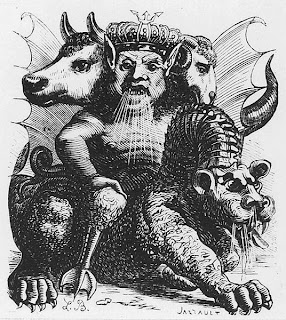
Asmodeus, the demon of lust (from his Facebook page).
So off goes Toby ("On your bike!" says his father, in some translations), and he meets the fish. Fortunately, he is under the protection of the angel Raphael, which means that he is going to win through in the end. He marries Sara, his kinswoman, and drives away the demon by burning the fish's liver in his bedroom. Of course, the bedroom smells of burnt fish for a long time afterwards, but this is a small price to pay for married bliss. Raphael binds the devil, and we hear no more of him. Do spare a thought for Raguel, Sarah's father, who digs a grave for Toby only to find that it isn't needed.
Toby goes back to see Tebbit, and uses the fish's gall to cure his father's blindness. Many years later, Tebbit dies, and Toby leaves Nineveh - which is doomed, as we'll see later when we reach Jonah - to return to the land of the Medes.
Toby and the fish.
Now, this is a great book of fish recipes, but that's not really the point. One of the themes - sorry, Graham, it really isn't your day - is marriage. And when the third night is past, thou shalt take the virgin with the fear of the Lord, moved rather for love of children than for lust, ... that sort of thing. Chapter 4, old Tebbit's advice to young Toby, is also hot on charity, wisdom, avoiding pride, praying, voting Conservative, etc.
Ah, Dawkins, I see your hand is up. I think I know what you're going to say: "Fish gall doesn't cure blindness, there are no such things as demons, or angels. Giving alms isn't going to benefit you personally. There's nothing wrong with a bit of lust." Shall we make it easy for you, as you're a beginner? Look at some of the instructive moral teaching, don't worry too much about the supernatural elements for now - I know they give you a headache - and leave it at that. Oh, and here's your guardian angel to escort you home.
John Cornwell? Doesn't he write rubbish books about popes called Pius?

Sunday, 9 February 2014
Cornwell cut off by a flood
N.B. The picture shows Nuncio Pacelli in 1927. Hitler was out.
Efforts are being made to bail out Cornwell, but the tide is definitely flowing against him, and it may be months before he can get back on the rails; at present he is completely off-track. The latest deluge to hit Cornwell is attributed by some to a change in the climate of opinion; by others, to a natural downfall.
Pope St Pius X - next for a hatchet job.
Amusingly described, variously, as a "Catholic", "historian" and "theologian", Cornwell has now been declared a complete disaster. His latest work, "The Dark Box" explains how Pope St Pius X encouraged children to go to confession; what a fiend that man was!
Naturally, the government and the environment agency are very concerned about the plight of Cornwell. Part of the problem is the collapse of the anti-Catholic line taken by Richard Dawlish, which has always looked to be on rather shaky foundations, and may not be worth trying to save.
Eric Pickles discusses the plight of Cornwell.
Surprisingly, the general public is not worried about "losing" Cornwell. Said one sockpuppet that we interviewed: "Where would we be without Cornish Nasties and Clottish Dreams? But Cornwell is too remote from reality to be worth worrying about."


