"That was a strange case, Hastings,
mon ami," said my friend Hercule Poirot. "I was taking the
ad Orientem Express to the mysterious east (Margate), to consult my
friend Fr Tim Finigan on a curious question of hermeneutics, when we were held up
by two or three snowflakes on the line - apparently, they were the wrong
kind of snow. Still, there we were, marooned in some uncharted wastes near Faversham,
with no hope of rescue for several days."

Somewhere near Faversham.
The chef de train summoned Poirot to one of the compartments, where there lay the dead body of
a fattish man in his early sixties. One could tell at a glance that
he was dead: there were stab wounds and bullet holes in various parts
of his body, a rope round his neck, an empty bottle of pills by his side,
and the marks of a blunt instrument on the back of his head. "His name
is Charlie Falconer, and he was some sort of gangster," commented the train guard. "Could it be suicide, M. Poirot?"

Charlie Falconer in happier times, singing the Nightmare song from Iolanthe.
Poirot examined the body carefully. "I think not, mon vieux. Someone
evidently helped him on his way. The worse case of assisted suicide that
I have ever seen. We must find an explanation for his death."
An eager, fresh-faced man joined them. "Hi! I'm Tony!" he said. "I used to be
something big in politics, but now I go round the world making money. Also
I've been bringing peace to the Middle East. Charlie was an old friend
of mine, and I gave him a job once."
"I have heard of you, Monsieur," acknowledged Poirot. "You are a pious
Catholic who supports abortion and same-sex marriage. Can you think
of any reason why M. Falconer could have opted for assisted suicide?"
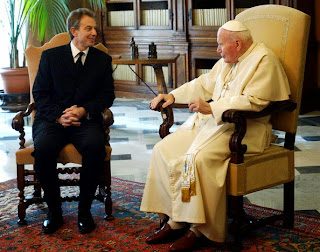
Tony gives Pope John-Paul II some tips on becoming a saint.
"Well, he had a sore throat, and he didn't like train journeys, and England did
badly in the World Cup, and he was worried about his pet hamster, Miliband, and
he scratched his car against the gatepost last week, and they'd run out of
gin, and he thought it might rain later, and..."
"I understand. All perfectly good reasons for a doctor to recommend assisted suicide. Now,
let us see if there are any likely suspects." At that moment, a strange
character entered the compartment.

John Birt. Formerly of the BBC.
"EX-TER-MIN-ATE! EX-TER-MIN-ATE! AS-SIST SU-I-CIDE! AS-SIST SU-I-CIDE!" screamed
Lord Birt, for it was indeed he. This was a man who had been Director-General of the BBC,
an organization that had employed megastars such as Jimmy Savile and Rolf Harris.
During his rule, it was said that more people had switched off their televisions
and said "I can't go on!" than ever before.
"There are indeed marks of extermination on Charlie Falconer's body," said
Poirot, "but they may have been inflicted after death." He was then
joined by a bumbling figure dressed as an Anglican archbishop.
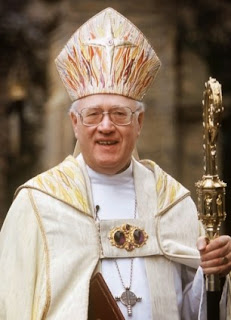
"And if my sermons don't finish them off, a good swipe with the crozier will do it."
"Hello, everyone, I'm George," said the man, who was wearing a strikingly silly
mitre and carrying a large blunt instrument. "I am man of
deep Christian principles. Can I be of assistance to you as you seek to
end your life in a truly Christian way?"
"No! No!" said Poirot. "I wish to live to be 130. Indeed, if Agatha
Christie doesn't
sort out the chronology of her stories, I may be forced to."
At that moment the compartment began to fill up with other well-intentioned
supporters of assisted death: apparently, the House of Lords had organized
a day trip to Margate for all its most irritating members.

Ian Blair as seen in "Hello (Hello, Hello)!" magazine, deals with the old and Sikh.
"You've all been very helpful," said Poirot. "Of great assistance, in fact..."